

Year 11 GCSE Maths: How to Prepare for Your Board Exams and Improve Your Grade
“`Year 11 is the time when GCSE Maths preparation becomes much more focused. Whether you are studying for Foundation Tier or Higher Tier, your final grade will depend not only on what you know, but also on how confidently and accurately you can apply your knowledge under exam conditions.
The good news is that Maths is a subject where regular practice can make a very significant difference. You do not need to be naturally brilliant at Maths to improve. You need a sensible study routine, plenty of question practice, careful review of mistakes and the confidence to ask for help when something does not make sense.
“`Why Year 11 GCSE Maths Preparation Matters
“`GCSE Maths is not a subject that can usually be mastered by simply reading a revision guide a few days before the examination. Mathematics requires active practice. You need to pick up your pen, attempt questions, make mistakes, understand those mistakes and then try similar questions again.
Official exam-board guidance also emphasises the importance of using past papers and mark schemes to understand the types of questions students can expect and how marks are awarded.
You need to DO Maths.
Foundation or Higher Tier: What Should You Focus On?
“`🟢 Foundation Tier
Foundation Tier is suitable for students working towards grades in the Foundation range. The priority should be to become extremely secure with the essential skills and avoid losing easy and accessible marks.
- Number and calculations
- Fractions, decimals and percentages
- Ratio and proportion
- Algebra basics
- Graphs and coordinates
- Geometry and measures
- Probability
- Statistics
- Calculator skills
- Problem-solving and worded questions
Foundation students should not assume that the paper will be easy. Later questions can still require careful reasoning and problem-solving.
🔵 Higher Tier
Higher Tier requires students to combine mathematical skills, interpret unfamiliar problems and work through more demanding algebraic, geometric and problem-solving questions.
- Advanced algebra
- Quadratics
- Graphs and functions
- Trigonometry
- Similarity and geometry
- Ratio and proportional reasoning
- Probability
- Statistics
- Multi-step problems
- Mathematical reasoning
Higher Tier is not simply Foundation Maths with a few harder questions. Students need to become comfortable with unfamiliar problems and explain or apply mathematical ideas rather than relying only on memorised procedures.
1. Know Your Exam Board, Tier and Specification
“`Before starting serious revision, find out exactly which GCSE Maths qualification you are taking. Your school will normally tell you whether you are studying AQA, Pearson Edexcel, OCR or another specification, and whether you are entered for Foundation or Higher Tier.
Do not revise randomly from videos and websites without checking that the content matches your specification. Use your exam-board specification or revision checklist as a roadmap.
Green = confident | Amber = needs practice | Red = need help
2. How Should a Year 11 Student Study Maths at Home?
“`One of the biggest mistakes students make is waiting until they have a large block of free time before starting revision. In reality, short, regular practice is often much easier to maintain.
⏱️ 20–30 Minutes
Do a focused Maths practice session rather than trying to revise everything at once.
✏️ Practise
Attempt questions yourself before looking at worked solutions.
🔍 Check
Use a mark scheme or teacher feedback to identify exactly where marks were lost.
📝 Correct
Redo questions you got wrong without immediately looking at the answer.
3. Regular Practice Is One of the Biggest Grade Improvers
“`Maths improves through repetition. The more often you practise a skill correctly, the easier it becomes to recognise what a question is asking and decide which method to use.
Think of Maths practice like training for a sport. You would not expect to become a better footballer by watching football for three hours. Similarly, watching Maths videos without attempting questions is not enough.
A simple weekly routine
| Day | Suggested Practice |
|---|---|
| Monday | Algebra practice |
| Tuesday | Number / percentages / ratio |
| Wednesday | Geometry / trigonometry |
| Thursday | Statistics / probability |
| Friday | Mixed questions |
| Weekend | Past-paper practice + review of mistakes |
4. Start Using Past Papers Properly
“`Past papers are one of the most useful tools available to a Year 11 student, but simply completing paper after paper is not enough. The real benefit comes from analysing the mistakes afterwards.
Step 1
Attempt the questions without looking at the answers.
Step 2
Mark your work carefully using the correct mark scheme.
Step 3
Record every question you lost marks on.
Step 4
Study the method and redo the question later.
The aim is not simply to say, “I scored 54 marks.” The better question is: “Why did I lose those 26 marks, and what can I do so that I do not lose them again?”
“`5. Keep a Maths Mistake Book
“`This is one of the simplest ways to turn mistakes into progress.
For every difficult question, record:
- Topic: e.g. quadratic equations
- What went wrong?
- Which method should I have used?
- What mistake did I make?
- Correct method
- One similar question to practise
6. Do Not Keep Difficult Questions to Yourself
“`One of the most common reasons students fall behind in Maths is that they become stuck on one topic, but continue moving forward without resolving the problem.
Perhaps you understand most algebra but cannot solve simultaneous equations. Maybe you can calculate angles but struggle with circle theorems. Perhaps you understand the formula but cannot recognise when to use it.
Ask for help.
Your classroom teacher should be your first source of support. Write down your questions and ask them specifically rather than simply saying, “I don’t understand Maths.”
Try: “I understand the first step, but I don’t understand why we divide by 3 at this stage.”

7. How Can You Find a Good GCSE Maths Tutor?
“`If your child needs additional support, choosing the right tutor can make a real difference. However, do not choose a tutor simply because they advertise themselves as a “Maths tutor”.
Look for these qualities:
They should understand GCSE Maths rather than only general Maths.
They should be familiar with the student’s specification and tier.
They should identify gaps rather than simply teach random topics.
They should use appropriate exam questions and past-paper practice.
The student should feel comfortable asking questions.
There should be a clear way to monitor improvement.
8. Why Online GCSE Maths Tutoring Can Be Helpful
“`For busy Year 11 students, travelling to a tuition centre or tutor’s home can consume valuable time. Online tutoring can remove much of that travel time and allow students to study from their own home.
⏰ Save Travel Time
Move directly from school or home study into a tutoring session without travelling.
💻 Learn From Home
A laptop, tablet or suitable device can provide access to a structured lesson.
📖 Digital Resources
Questions, worksheets, diagrams and worked solutions can be shared digitally.
🎯 Targeted Support
Lessons can focus specifically on the topics where the student is losing marks.
Online tuition is not automatically better than face-to-face tuition. What matters most is the quality of teaching, interaction, structure, feedback and consistency. A good online lesson should still be highly interactive: the student should be solving questions, explaining methods and receiving immediate feedback.
“`
9. How Can You Actually Improve Your GCSE Maths Grade?
“`Improving a grade is usually not about suddenly learning hundreds of new topics. Often, significant progress comes from identifying the marks that are currently being lost and fixing the underlying problems.
- Find your weakest topics.
- Practise those topics regularly.
- Review mistakes carefully.
- Ask your teacher or tutor about persistent difficulties.
- Return to the same topic after a few days.
- Practise mixed questions so you learn to identify the method yourself.
- Complete timed past papers.
- Analyse every lost mark.
- Repeat the process.
Learn → Practise → Make mistakes → Understand → Correct → Practise again → Improve
10. Develop Your Exam Technique
“`Knowing Maths is only part of the challenge. You also need to be able to demonstrate your mathematical thinking clearly under timed conditions.
- Read every question carefully.
- Underline important information in longer questions.
- Write down your working.
- Do not spend too long on one question.
- Return to difficult questions later.
- Check calculations where possible.
- Use your calculator appropriately.
- Check units and rounding.
- Make sure your final answer actually answers the question.
- Never leave a question blank if you can make a sensible attempt.
Exam technique can be especially important because marks are not awarded only for getting a final number correct. Showing appropriate working can help demonstrate the method used.
“`11. What Should You Do in the Final Weeks Before the Exam?
“`Week 1
Identify weak topics and create a revision checklist.
Week 2
Target weak topics with focused practice.
Week 3
Increase mixed-question and exam-style practice.
Final Stage
Complete timed papers, review mistakes and refine exam technique.
Do not spend all your revision time repeatedly doing topics you already find easy. Maintain your strengths, but give additional time to the areas where you are losing marks.
“`12. Advice for Parents of Year 11 GCSE Maths Students
“`Parents can provide valuable support without becoming the Maths teacher.
- Help your child establish a regular study routine.
- Encourage consistent practice rather than last-minute revision.
- Ask what topics they are currently studying.
- Encourage them to speak to their teacher when they are stuck.
- Help them find appropriate additional support if necessary.
- Celebrate improvement and effort, not only final grades.
- Make sure they have a quiet place and suitable time for study.
- Encourage healthy sleep and breaks during intensive revision.
A student who is struggling with Maths does not necessarily need more hours of revision. They may need better-targeted practice and clearer explanations.
“`Final Thoughts: Start Now, Practise Regularly and Ask for Help
“`GCSE Maths success is rarely the result of one huge revision session. It is usually the result of many smaller, consistent actions repeated over time.
Whether you are preparing for Foundation or Higher Tier, focus on understanding the mathematics, practising questions, learning from mistakes and becoming increasingly confident with unfamiliar problems.
If you are struggling with a particular topic, do not wait until the week before the examination. Speak to your teacher, ask questions and consider getting additional support from a suitable GCSE Maths tutor.
Your goal should not simply be to revise more. Your goal should be to revise smarter, practise consistently and turn your weaknesses into strengths.
“`Looking for GCSE Maths Online Tuition?
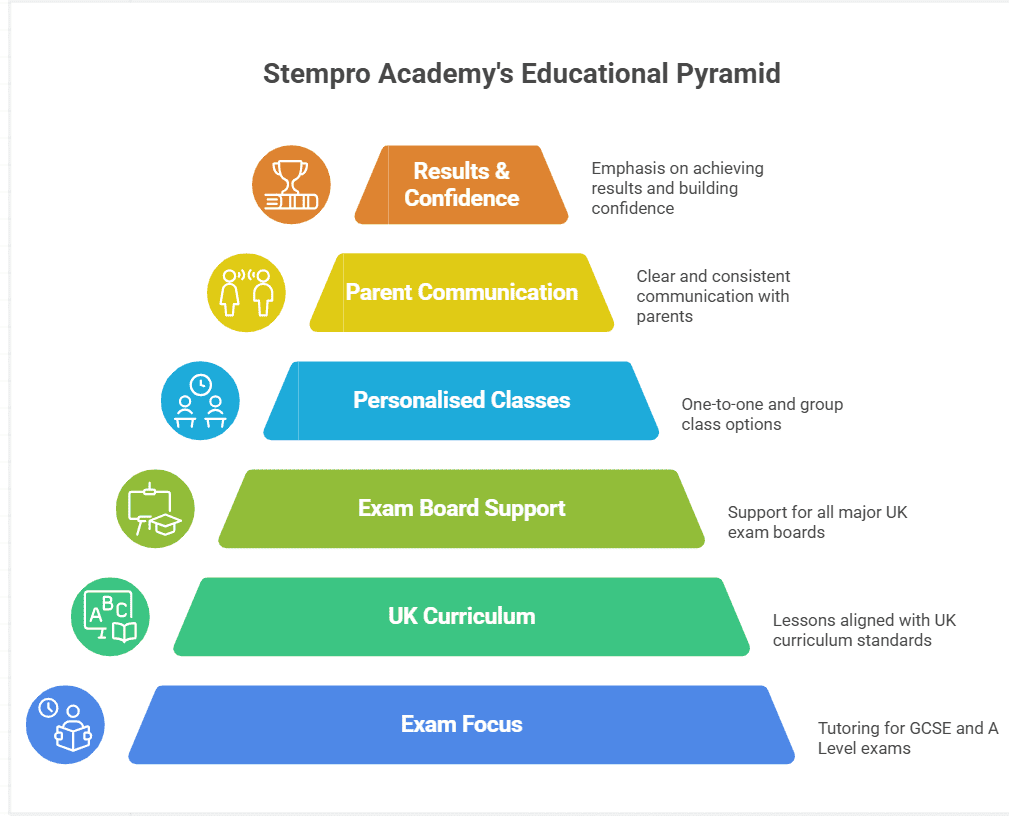
STEMpro Academy provides online Maths and Science tuition designed to help students build confidence, strengthen their understanding and prepare effectively for GCSE examinations.
Whether a student is working towards Foundation or Higher Tier, targeted support can help identify gaps, practise exam-style questions and develop better problem-solving skills.
Explore STEMpro Academy Book a Free Trial “`